
Publication status
Research 17 — Russian Semantic Source v1 Frozen. The canonical Russian version of the conceptual architecture and the preregistration specification. Empirical validation of the architecture has not yet been performed.
DOI: 10.5281/zenodo.22013923 — the English preprint is deposited in Zenodo (CERN) under CC BY 4.0. Please cite the DOI.
This status does not imply a finished implementation, a proven superiority, or production readiness. This English text is a translation of the frozen Russian source through the shared Arcanada glossary, not an independent academic rewrite.
From the original abstract
The available sources are heterogeneous: queries, search results, memory, instructions, tools, Policy, and model assumptions together form the available context, yet they do not automatically determine which task-specific semantic commitment has been selected, how it was issued, what realizes it, or whether a particular action is permitted.
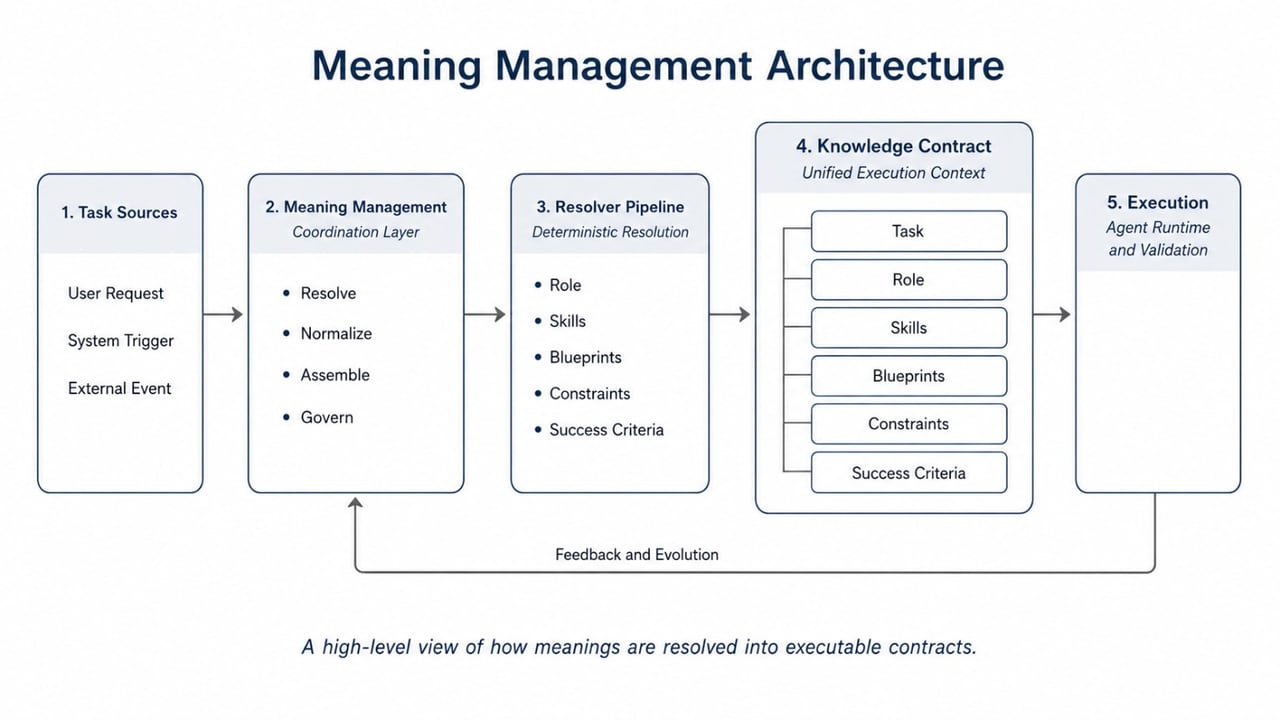
The central contribution is Meaning Management as an architectural layer governing the lifecycle of task-specific semantic commitments. The selection is fixed by a Resolution Receipt; the Knowledge Contract is separated from issuance; post-issuance Binding is separated from the current Authorization. Variant A, the BKG, the Resolver, the identity model, Expansion/Evolution, and the execution gate formally specify the mechanisms that support this decomposition.
The surveyed purposive corpus covers prompting, retrieval, memory, orchestration, provenance, workflows, policy evaluation, and knowledge representation individually, but provides no single model of this governed transition; the finding is bounded by the corpus and asserts no historical priority. Practical usefulness is tested by nine hypotheses and nine protocols, HYP/EXP-001–009. The experiments have not been run, so error reduction, improved diagnosis, and acceptable cost are not demonstrated.
By Pavel Valentov · Knowledge Contract Arcana · CC BY 4.0. Text retained; presentation adapted.
Read the full article on Arcanada